
Your Skin Routine Has Stopped Working – Here’s How to Repair Skin Barrier Damage
April 7, 2026 2026-09-16 14:53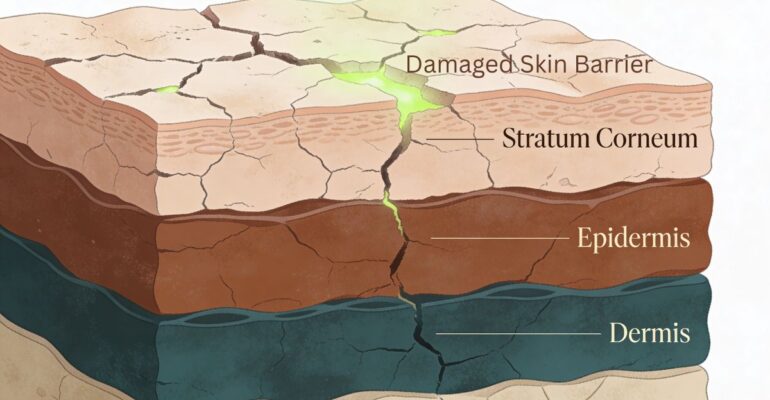
Your Skin Routine Has Stopped Working – Here’s How to Repair Skin Barrier Damage
You have a routine. You have been consistent with it. Yet your skin behaves as though none of it is working. Before you replace anything, read this. The problem is likely not your products. It is almost certainly your skin barrier.
What is the Skin Barrier?
The skin barrier, known scientifically as the stratum corneum, is the outermost layer of your skin. Think of it as a tightly sealed wall made up of skin cells held together by lipids, ceramides, fatty acids, and cholesterol. Its job is to keep moisture in and environmental irritants, pollutants, and bacteria out.
When it is working correctly, your skin feels comfortable, holds hydration well, and responds predictably to products. When it is not, everything changes.
Damaged Skin Barrier on Melanin-Rich Skin: Why It Worsens Hyperpigmentation
A compromised skin barrier does not just cause dryness. It creates a chain reaction across every other skin concern you may be managing.
When the barrier is damaged, moisture escapes continuously. This process is called transepidermal water loss. Your skin becomes dehydrated no matter how much moisturizer you apply. At the same time, irritants that a healthy barrier would block begin to penetrate, triggering inflammation. For melanin-rich skin, that inflammation directly stimulates melanocyte activity, meaning a damaged skin barrier actively worsens hyperpigmentation.
That is why barrier health isn’t separate from uneven tone, sensitivity, or breakouts. It is the foundation that determines how well your skin manages all of them.
Damaged Skin Barrier Symptoms You Shouldn’t Ignore
Your skin will tell you. These are the most common signals:
Sudden sensitivity to products you have used before
If a cleanser, serum, or moisturizer that worked well for months is now causing stinging, redness, or irritation, your barrier has likely weakened. The products have not changed. Your skin’s ability to tolerate them has.
Tightness that does not resolve after moisturizing
Healthy skin retains moisture between applications. If your skin feels tight or uncomfortable within an hour of moisturizing, your barrier isn’t holding hydration effectively.
Dullness and uneven texture
A compromised barrier disrupts the skin’s natural renewal process. The result is a dull, rough surface that responds poorly to treatment products.
Breakouts in areas that are not typically congestion-prone
When the barrier is breached, bacteria and environmental irritants enter more easily. This can trigger breakouts in areas where you do not normally experience them.
Hyperpigmentation that is worsening or not responding to treatment
If your correcting routine has stopped producing results, or existing dark spots are deepening, a compromised barrier may be the reason. Correcting ingredients work far less effectively on skin that is inflamed and reactive at the barrier level.
What Damages the Skin Barrier
Understanding the cause is as important as treating the result. The most common barrier disruptors are:
Over-exfoliation: using acids or physical exfoliants too frequently strips the lipid layer faster than the skin can rebuild it.
Harsh cleansers: surfactants that leave the skin feeling squeaky clean are often too stripping. That tight feeling after cleansing is not clean skin. It signals a disrupted barrier.
Skipping SPF: UV exposure degrades the lipid layer over time, accelerating barrier breakdown.
Environmental stress: pollution, low humidity, and air conditioning all draw moisture from the skin and weaken barrier function.
Switching products too frequently: introducing too many new actives at once or changing your routine before it has had time to work creates chronic low-level irritation.
Your Skin Barrier Repair Routine: Step-by-Step
Rebuilding the barrier requires a specific approach. This is not the time for active ingredients, aggressive treatments, or product experimentation. It is time to simplify.
Protect: How to Repair Skin Barrier Damage With Daily SPF
Continue wearing SPF daily without exception. UV exposure will continue to degrade the barrier even as you try to repair it. Sun protection is non-negotiable at every stage of skin health.
Correct: Pause Actives While You Repair Your Skin Barrier
Pause any correcting actives that may be contributing to irritation. Vitamin C, retinoids, and high-concentration acids all require a functioning barrier to be tolerated well. Reintroduce them one at a time once the skin has stabilized.
Renew: Gentle Ingredients That Support Skin Barrier Repair
Support the skin’s natural cell turnover gently. Rather than exfoliating, focus on ingredients that promote healthy renewal from within. Niacinamide, panthenol, and peptides are well tolerated during barrier recovery and support skin repair.
Preserve: The Core of Your Skin Barrier Repair Routine
This is the priority. Focus on ingredients that replenish and seal the barrier: ceramides to restore the lipid layer, hyaluronic acid to draw and hold moisture, and occlusives to prevent further water loss. Apply moisturizer to damp skin to maximize absorption and lock in hydration immediately.
Give the skin at least 6-8 weeks of consistent, gentle care before reintroducing anything stronger.
The Right Starting Point
Skin barrier damage rarely happens in isolation. It is usually connected to other concerns such as hyperpigmentation, dehydration, and breakouts, which is why understanding your full skin picture matters before making routine changes.
The Ageless Belle® Skincare Guide is a free resource that walks you through reading your skin, identifying what your barrier needs, and building a routine that works from the foundation up. It is the clearest place to start before making any adjustments.
Download it for free here.
Final Thought
The skin barrier is not one concern among many. It determines how well your skin handles every other concern. Get it right, and everything else in your routine works better.
